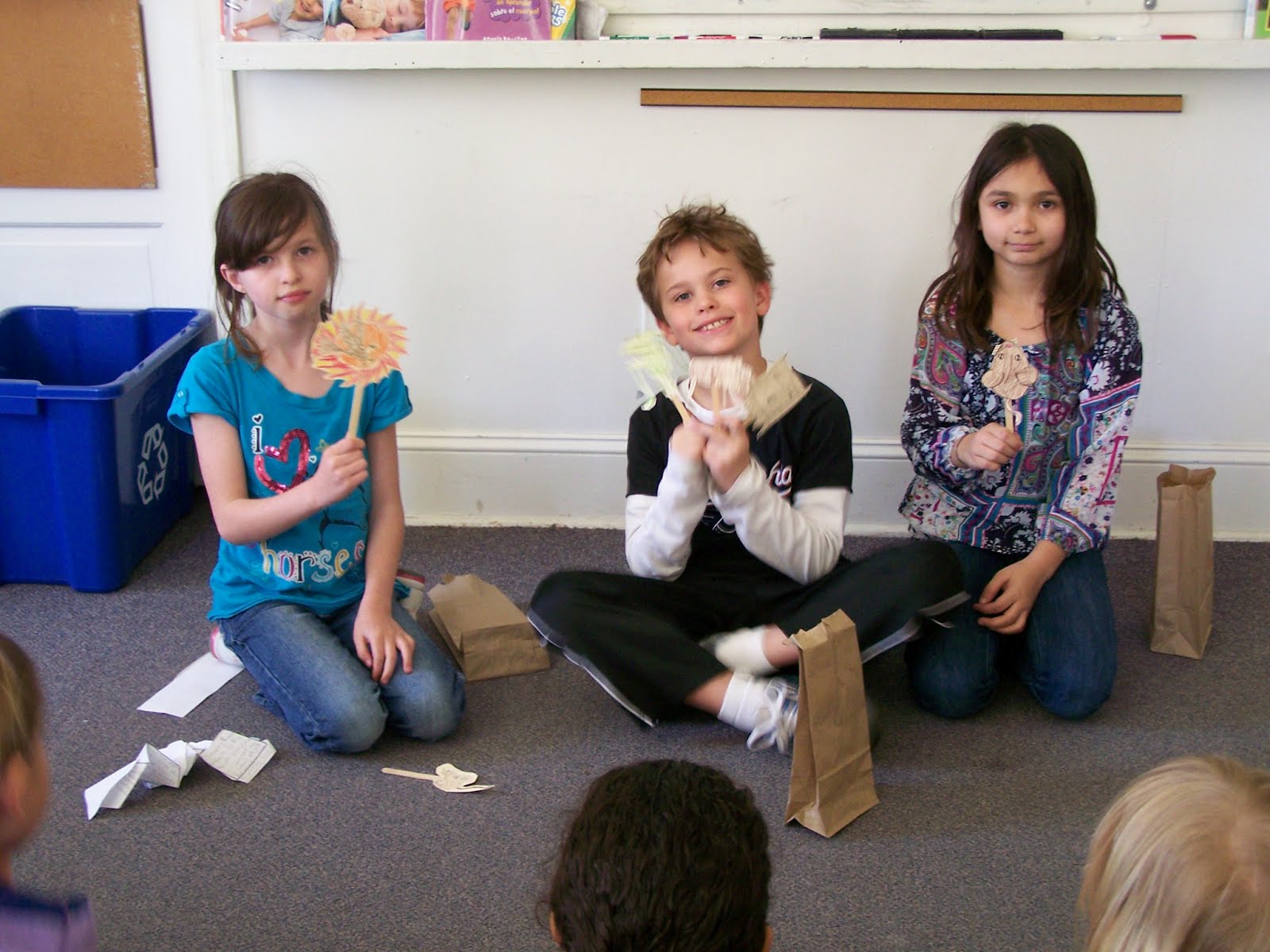
The Folktale Festival wraps up tomorrow. More to come . . .
Welcome
(* From the song "Circle of Friends" by Roger Emerson)
Wednesday, April 4, 2012
Folktale Festival - Day Two
The Folktale Festival wraps up tomorrow. More to come . . .
Tuesday, April 3, 2012
Folktale Festival - Day One
Today is the first of our three-day Folktale Festival, a celebration of this year's All-School Unit, "Folktales and Legends." Since the beginning of the year, students have been learning about this theme through special lessons and activities with their classroom teachers and in many of the special area subjects. These festival days provide an opportunity for students throughout the school to share what they have learned and accomplished with each other, and to celebrate the art of story telling.At the conclusion of this morning's very first performance (kindergarten's puppet show for the fifth grade) I smiled at the realization that the festival was already meeting one of it's major goals. It was gratifying to hear our oldest students offer very specific and thoughtful words of affirmation and commendation to their younger buddies. Similar interactions happened throughout the day as children of various ages asked questions and appreciated each others' work.
Some of the events were designed specifically for a student audience, while others lent themselves to include parents. I have the great privilege of taking in all of the festival performances, displays, and activities. am glad to share the following images from the day . . . with more to come tomorrow!
Day One

Kindergarten's puppet show, "Tales of Kindergarten," explained various parts of their day (morning message, math, science, music, etc.) to their fifth grade meeting buddies.
First grade presented two shadow puppet shows: The Rumor, A Jataka Tale from India (taken from the book by Jan Thornhill) and The Rooster's Antlers, A Story of the Chines Zodiac, as retold by Eric A. Kimmel. Fifth graders recognized characteristics of the Indian story from their own study of Jataka tales.
Pre-kindergarten acted out the story of Kumak's Fish, A Tall Tale from the Far North, by Michael Bania, as narrated by T. Annmarie. Their performance was recorded in order to spare them the pressure of a live performance. Parents got to see the video today, and the rest of the school will view it on Thursday.
Second graders hosted visitors to their "Fairy Tale Gallery," where original fairy tales and illustrations were on display, as well as castles created through cooperative teamwork. Visitors enjoyed snacks of ogre eggs and troll stew!
In art class, second graders glazed their ceramic dragons.
Third graders, divided into small groups, shared The Story of Jumping Mouse, a Native American tale from the Plains region, with first grade audiences.
Fourth grade told The Groundhog Wars, a Pennsylvania folktale by Robin Moore, using expressive narration and handmade illustrations (including a homemade version of a "tunnel tickler").Robin Moore will be our visiting artist tomorrow. Until then . . .
Tuesday, November 22, 2011
Listen!
Last month I wrote about story telling. Recently I’ve been thinking quite a bit about the flip side of story telling: namely, listening.
Active listening is as important a skill as the ability to create, write, and tell stories. If stories (as I wrote last month) help to weave the fabric of our society, bind us together, and are integral to the human experience, then it should go without saying that intentional and focused listening is also right up there on the hierarchy of essential skills.
The encouragement and development of listening skills occurs at West Chester Friends School from the earliest moments of each day. During morning meetings (an integral part of Responsive Classroom), students and teachers first greet each other while making eye contact and using names, taking turns to speak and listen to each other - a simple task that is at the heart of good communication. Morning meetings also include sharing when, again, as much emphasis is placed on listening and asking questions as on whatever is being shared.
Listening is essential to learning experiences throughout the day and is particularly important during special events. When, for example, the fifth grade opened the doors to the Native American museum they created last week, younger students were instructed before entering to be a good audience for the oldest students’ presentations - and they were! Tomorrow, during Grandparents and Special Friends Day, many students will spend time hearing about what school and life in general were like for their elder friends. Such inter-generational conversations are invaluable.
Meeting for Worship is the centerpiece of our week. While some may say that it is simply “sitting in silence,” it can be a much deeper experience. Many Quakers describe meeting as sitting “in expectant waiting,” listening for the “still small voice” that is in each one of us. While the “success” of a meeting does not depend upon whether anyone speaks, it is encouraging when students do rise to share a message - what Quakers call “vocal ministry.” The act of listening to these messages, and taking them with us, play an equal role in the vitality of a meeting.
Last week I had the good fortune to hear Michele Norris, co-host of NPR’s All Things Considered, speak about her new book, The Grace of Silence. In the wake of the 2008 presidential election, she had “set out to write a book exploring America’s hidden conversation about race but changed course when (she) started listening to the hidden conversations in (her) own family.” In several cases, Norris told her audience, she needed to wait patiently for months before some stories were shared. The result of her patience and listening is a compelling memoir, not only of her family, but of a not-so-distant piece of our nation’s story.
From Michele Norris I also learned about the National Day of Listening, which is coming up this Friday. The day was established by StoryCorps as an encouragement to sit and have a meaningful conversation with someone special on the day after Thanksgiving, rather than head to the mall. You may be familiar with StoryCorps’ project to collect audio recordings of interviews as an oral history archive. Trying to accomplish that may be too much for this weekend, but it’s not too much to simply sit with a relative or friend . . . and listen.
This year, the theme for the National Day of Listening is “Thank a teacher,” with the suggestion that we reach out to a favorite teacher - by calling, writing a note, or posting a message on their site - to say, “Thank you for touching my life.”
What better way to show that we were listening?
Thursday, October 20, 2011
Will You Tell Me a Story?
“Will you tell me a story?”
These words evoke an image of a young child sitting on a lap or under the covers wishing to hear another tale told by a caring adult – a nostalgic scene that we remember from our childhoods and, if we’re lucky, get to relive in our adulthood as the storytellers.
We all have stories to tell. When we share our experiences by telling and listening to stories, the fabric of our society is woven. Stories bind us together and are integral to the human experience. They inform us about our past and help us make sense of our present. As it turns out, they are also essential to navigating our way in the future. As Daniel Pink explains in his New York Times bestseller, A Whole New Mind, story is one of six right-brained aptitudes that are necessary for success and fulfillment in what he calls the Conceptual Age, and that are often under-emphasized in schools. As we emerge from the Information Age, with facts being “so widely available and instantly accessible, each one becomes less valuable. What begins to matter more,” Pink writes, “is the ability to place these facts in context and to deliver them with emotional impact. And that is the essence of the aptitude of Story – context enriched by emotion . . . a deeper understanding of how we fit in and why that matters.”
Story is a part of our daily lives at WCFS beginning with our youngest students and the earliest minutes of every day. Students begin their day with Morning Meeting which often includes time for children to share what is important to them – their personal stories. Literature is the foundation of everything that we do in the language arts; in order to tell a story, you need to be able to hear and read a story. As students learn to write, they draw first upon personal experiences for subject matter. Third graders learn, record, and pass on their families' stories as part of their study of Immigration. Storytelling is even a part of music classes, where instruments are used to evoke feelings and emotions in the telling of "sound stories." Intergenerational experiences such as Grandparents' Day and visits with our neighbors at The Hickman are reminders that listening is a major (and often overlooked) component of storytelling. This year, the faculty have chosen “Folktales and Legends” to be our all-school theme, placing even greater emphasis on the lessons to be learned from tales of the past.
As members of the WCFS community, we all have stories about our most memorable school experience. One of my favorites is about the birth of our daughter on the first day of school in my first year as Head of School. On the other end of the spectrum, I recently recounted on my blog the story of how, just five days later, we experienced the events of September 11 here at school.
I invite you to share your WCFS stories. In celebration of the school’s 175th year, we are collecting 175 memories from alumni, alumni parents, current and former faculty and board members, Meeting members, and friends. Any and all memories are welcome from specifics about a particular teacher, activity, subject or event, to something broader (“I loved playing on the lawn.”). Short or lengthy, funny or poignant, we want to hear what you think of when you remember WCFS. The stories will be compiled in a book that will be available for purchase and go in our archive. Some will also be shared on our web site. You may mail your memory to the school, email development@wcfriends.org, or leave a message at 610-696-2820.
Will you tell us a story?
Thursday, September 15, 2011
What a Way to Start the Day, the Week, the Year
Every week at West Chester Friends School begins with a celebration of community called “Gathering.” All of the students and teachers form a circle in the schoolyard and greet each other by shaking hands and saying, “Good morning,” with those on either side. Children are encouraged to include their friends’ names and to smile. You can feel the mood lift when there are smiles passing around the circle.
Next, students from each class share a highlight from the previous week or their anticipation of something in the current week. This week, for example, fourth grade announced their Word of the Week (it’s “cygnet,” which means “a young swan”), fifth grade told us that homework had begun, third grade welcomed a new student, second grade shared that they learned a card game to help with math facts, first grade announced that they are making their doves, and kindergarten proclaimed, “Kindergarten is fun!”
The greeting and sharing are elements from the Morning Meeting, an aspect of Responsive Classroom which happens in the kindergarten through fifth grade classrooms every morning (pre-kindergarten introduces these elements later in the year).
Children whose birthdays are coming up in the week hear their name called and receive the well wishes of everyone in the circle. Announcements are then made. These range from reminders of upcoming events to recognition of a job well done. Finally, we sing a song – an uplifting way to transition into the rest of the day.
With this being the first week of school, T. Rege arranged for Sage Larsen ’13 to perform a song that has a wonderful story behind it. Five years ago, when Ellie Kerns ’11 was in first grade studying the Civil Rights Movement with T. Connie, she wrote the song, “Stand Your Ground.” She and her classmates performed the song at Gathering that year, and we have enjoyed it from time to time since then. This summer, Ellie and Sage attended a week-long band camp, during which they rewrote some of the lyrics, wrote the music, performed and recorded a dvd.
Listen to a version of the song with both girls singing. It was recorded in a studio and includes piano and drums in addition to Sage’s guitar. While you listen carefully to the words, imagine Sage standing in the circle with just her acoustic guitar, singing confidently for all of us.
Friday, September 9, 2011
September 11 Remembrance
The view from the pediatrics ward on the fourth floor of the hospital that Tuesday morning was of what I have come to know as “a beautiful Chester County day.” Rolling green hills lay beneath a clear blue sky. The scene provided welcome respite from the stress of having our five-day-old daughter admitted the previous evening to be treated for a jaundice-related issue – a somewhat common condition that did not seem so common to these novice parents. It was only the fourth day of school in my first year as Head of School, but I felt comfortable being with my wife, Melinda, and our daughter knowing that the school was in good hands.
A nurse walked into the room and turned on the television, saying, “You have to see this.” The North Tower of the World Trade Center had been hit by an airplane. Melinda encouraged me to go to school, but I replied that this was happening far enough away that it wouldn’t affect us. Then the second tower was hit.
When I arrived at school minutes later, the administrative team was already gathered in my office and well into developing a plan to handle the situation in our school. Maintaining a mood of calm was imperative. Adults were given space to gather and process the events while taking precautions against sharing information or their reactions with the children, knowing that the manner in which we conducted ourselves would go a long way toward how the children responded.
Several parents arrived on campus throughout the day to check on their children. Some planned to take their children home, but none did. Seeing and feeling the sense of calm and normalcy, they chose to have their children remain, and many of them remained, as well.
The parents who stayed at school joined the teachers and students (except for pre-k and kindergarten, who had a half day) as we gathered in the meeting house before dismissal. I spoke with the children to provide a bare outline of the events in New York, Washington, and Shanksville – at least as we knew them at the time – so that they would not be caught unaware by bits of information that might emerge on their trips home. I asked everyone to hold the victims and the people who had done these acts in the Light and we settled into silent worship.
A letter went home with every child explaining to parents how we had handled the day and how we would continue to address the issue in school. The letter also contained suggestions from John Scardina for how parents might discuss the issue with their children, as they would be taking on the burden of explanation and comfort.
I share this remembrance of September 11, 2001, for a few reasons. First, it is a part of our school’s history that so few of you know, since all but six of our families have joined the school since that time. More importantly, I share this story because of what it says about a precious quality of this school – namely, the child-centered thoughtfulness with which we approach even the most difficult of situations – and because our experience in 2001 informs how we are handling the anniversary ten years later.
The faculty has affirmed that it is most appropriate that we not mark the anniversary in any way. As adults, we mourn the thousands of lives lost, and honor those who responded to the crisis and have dedicated themselves to improving our security since then. Our children, however, are simply too young. Most of them were not even born at the time and, while some may know of the attacks, none of them are fully capable of processing the feelings of uncertainty and fear that would inevitably come from focusing on the event. While the teachers will not be bringing up the subject, we recognize that a child may. Should this occur, the teachers are prepared to address the issue in a manner appropriate to the setting and the ages of their students.
Parents may also want to be prepared to answer questions that children may ask. Some of the advice that John Scardina shared in the letter to parents on September 11, 2001, remains helpful today:
- Limit the amount of information you share to a level appropriate to your own child's age and development.
- Accept your child's feelings for what they are – they may show a wide range of reactions, and your willingness to sit with them and not edit those feelings will be of most help.
To these, I would add that we should monitor our children’s access to all forms of media. Television and radio programs are already on the air, some which include raw footage and detailed descriptions. If you must have the television or radio on, watch and listen together, and do not hesitate to turn it off.
Finally, I recommend these short articles on the KidsHealth from Nemours (A. I. duPont Hospital for Children) web site: How to Talk to Your Child About the News, and Remembering September 11. This second article is written for kids and is appropriate for some of our older students. Parents will find it helpful, too.
Wednesday, September 7, 2011
Hopes and Dreams for the New Year
Greetings from West Chester Friends School on this first day of school. I have returned to my office after being a part of classroom visits for children in the Early Childhood classes. Students in grades one through five are snuggly settled into their rooms learning the routines that will guide them through the year. There is a palpable sense of joy among all of them, mixed with a bit of nervous energy. I know their teachers are very happy that they are here and the year is underway.
In our family, as with many families, we have first-day-of-school routines: clothes carefully chosen, backpack thoughtfully packed, and a photo at the front door. Many parents gather here at school as the children line-up, call out wishes of good luck as the students enter the building, and then linger for a while together. Today’s rain dampened the picture-perfect ceremonial quality of the morning, but not the excitement.
Indeed, the start of a new school year is always accompanied by great expectations. As parents and teachers, we want the best for our children. But what is it, exactly, that we expect?
What are your hopes and dreams for your child’s school experience? I encourage all of us to pause and answer this for ourselves today. If you are like me, you hope for joyful learning that strengthens their knowledge and skills. I dream of caring relationships that nurtures their social and emotional growth. This sounds utopian, I know, but I have confidence based upon my experience that all of this will happen for them.
I also know that it won’t be perfect. There will be struggles and frustrations in mastering new concepts and behaviors. There will be inevitable conflicts in relationships. I will cringe instinctively when things don’t go well for them. However, if I’m being honest, I know that my hopes and dreams include these experiences, too. I want my children to feel discomfort, and to face conflict . . . and to develop the resilience to handle such situations. I want them to feel free to take risks, and I want them to make mistakes. Otherwise, they will not truly learn.
One blog that I follow is written by Rick Ackerly, an experienced educator and author of The Genius in Children. Rick wrote eloquently about this same topic the other day, and I encourage you to read the full post. He ends with this “blessing for all the children on the first day of school, and every day thereafter:
May you develop the grit to live in life’s tensions, the confidence to learn from conflict, mistakes, disappointment, failure, loneliness and losing, and the skills to find the fun in every day and the love in every person. In the process may you never fall out of love with learning.
I invite you to share your hopes and dreams for the coming year by commenting below.