Welcome

Welcome to our "Circle of Friends."* This blog is written by the Head of West Chester Friends School and intended for members of the WCFS community and anyone interested in learning more about our school. Some posts include topics discussed at the monthly "Chat with Matt" parent coffees. Other posts share Teacher Matt's thoughts and observations as well as news and happenings from around the School. Happy reading!

(* From the song "Circle of Friends" by Roger Emerson)

Sunday, June 30, 2013

Of Songs, Family, and Journeys . . . and Farewell

I am writing this to you on my last official day as Head of West Chester Friends School.  Yesterday I passed my set of keys on to Lynn Oberfield, who will be Interim Head of School for the coming year.  I am thrilled that Lynn has accepted this role, and know that she will serve our school with wisdom and compassion.

Being Head of School is a job that I truly love, and I am grateful to have had the honor of serving in this capacity at West Chester Friends School for the past twelve years.  Two aspects of my job that I particularly enjoy are when I have the opportunity to write and speak – especially when doing so involves reflecting upon the shared experiences of our school community.  As I have approached the end of my time at WCFS, I have done quite a bit of reflecting upon my experiences over the past twelve years.  I had the chance to speak about them at the party that was held for my family and me (with many thanks to those of you who attended!), and am pleased to repeat them here. 

(Side note: It is interesting to me that when I began at the school a letter like this would have been printed, copied, and sent through the mail.  While some letters still go out that way, today’s default is to send by email and post on the blog.  I suppose that’s one way to measure the passing of twelve years!)
 
Of Songs, Family, and Journeys

My West Chester Friends School experience began with a song.  My very first day on campus, when interviewing for the position, included a meeting with Teacher Gerri’s fifth grade class who had carefully prepared questions to ask me.  Teacher John Scardina was in the room as a member of the search committee and suggested that they begin by singing “Circle of Friends” for me.  I happened to be familiar with the song and sang along.   The expression on John’s face revealed that he was both surprised and impressed.  No matter how qualified I may or may not have been for the job, I like to joke, the fact that I already knew “Circle of Friends” had sealed the deal!

I am fond of saying that “this is a school that sings.”  Singing has long been a part of the school’s culture, and it is even more so today than when I began.  I am proud of that fact.  The expression can be taken literally.  We sing every Monday morning at Gathering.  The monthly Meeting for Singing is a new tradition which many believe is perhaps the most beautiful illustration of the spirit of our school.  Commencement exercises include four times as many songs as they did twelve years ago.  “A school that sings” is also a metaphor.  The harmony that comes from teachers working together and the joyful buzz that emanates from the classrooms and across the school yard are all made possible through many voices figuratively joining together in song.  And, as we all know from having tunes stuck in our heads, good songs stay with us.

We often refer to WCFS as a community.  For my family, that sense of community has special meaning.  When we arrived in West Chester, my wife Melinda was pregnant with our first child.  Being the daughter of two teachers, Ellie dutifully arrived on the first day of school.  From that day forward, my experience as Head of School was intertwined with our experience as parents.  When, four years later, Ellie entered pre-kindergarten (to be followed by her brothers, James and William), I had the great fortune to see the work of our teachers not just through the eyes of a proud boss, but also through the eyes of an appreciative parent.  Melinda and I will be forever grateful to the entire faculty, staff, and administration for the incomparable learning experiences they provided our three children, and for the love and care that they so freely shared with them – and with us.

Journeys can be exciting and sad, all at the same time.  As my daughter recently pointed out, we never know as much about where we are going as we do about what we are leaving behind.  And this brings me back to songs.  Good songs stay with us.

The WCFS experience is a song.  Those of us who leave – whether we've graduated or retired or are moving on to a new school – take the song with us wherever we go.

Our family's journey here began with a song when this “Circle of Friends” opened to welcome us in.  Twelve years later, some new songs have been added to the school’s repertoire.  One of my new favorites is “River,” in which the singer is taken along on a river's journey from the mountains “down to the sea.”  During our last Meeting for Singing of the year, I paid greater attention to the lyrics than I had before and, to use a Quaker expression, found that they “spoke to my condition.”

I've been to the city & back again
I've been moved by some things that I've learned
Met a lot of good people & I called them friends
Felt the change when the seasons turned

So here's to the rainbow that followed me here
And here's to the friends that I know
And here's to the song that's within me now
I will sing it where'er I go


In peace and friendship, farewell!

("River" by Bill Staines, copyright Mineral River Music)


Friday, April 26, 2013

Earth Day and Good Manners


The daffodils have bloomed in the bird garden, the magnolia tree by the Activities Building is in its full glory, and Jeremiah the Bullfrog has made his presence known in the pond. Spring has definitely arrived here on campus!

This past Monday was Earth Day, which is both a celebration of spring and a reminder of our responsibility to be good stewards of the environment. In recognition of the day, our entire school enjoyed lunch and play time together on the lawn. Then we split into our mulit-age worship sharing groups to participate in four activities: a recycling relay;
an “Earth Toss” game; creating a work of art from recycled materials; and decorating a globe with paper doll versions of ourselves that included “what I value about the Earth” statements. In addition to being a lot of fun on a beautiful afternoon, the activities were opportunities to practice stewardship (which is the Quaker testimony we have been focusing on this month), and encourage the children to take these skills and behavior with them into their homes and into the wider world.

At Gathering that morning, we focused on another category of “skills and behaviors” that we hope our children will take with them out into the world: good manners. WCFS students are generally polite young people, but there's always room for improvement when it comes to exhibiting our best behavior at all times. Teacher Caroline and I performed a brief skit that emphasized the importance of a proper greeting. Our students are well practiced at greeting each other properly during morning meetings. They shake hands, make eye contact, and use each others' names. We don't need to stop and shake hands every time we see someone during the day, but I encouraged everyone to try during the week to make every greeting more than just a half-hearted hello. We will highlight a different manner at each Gathering through the end of the year. Next week's topic: table manners!

Monday, February 25, 2013

Behind the Scenes on In-Service Day

A week ago today we were on the tail end of a long weekend – a weekend that, for some, was a bit longer than for others. Students and (hopefully) their parents enjoyed a four-day weekend. For members of our faculty it was a three-day weekend, as we spent that Friday at school for an in-service day.

I imagine our students might sometimes wonder, “What do teachers do at school when we're not there, anyway?” I thought I would describe a bit of this most recent in-service day, in part to answer the question (in case you were wondering the same thing) and also to provide a glimpse into the kind of professional discourse that occurs among our faculty.

Generally speaking, an in-service day provides a chance for the faculty to spend an extended amount of time on a topic or task; more time than we have, for example, in faculty meetings that occur after a school day. Sometimes the day involves a guest speaker or training, or time for committees to meet, or time for teachers to write progress reports.

On this in-service day, we chose to spend time on a few topics that are of particular interest to various members of our faculty and about which all of us would benefit from learning and discussing. Here is a sampling:
  • Teacher Amy led a mindfulness relaxation exercise called “anchor breathing.” Students have been learning mindfulness practices, which increase focus and decrease stress and anxiousness, in guidance classes. Becoming familiar with these practices as teachers is good for each of us, individually, and paves the way for making them part of our daily routine with students.
  • We viewed a TEDTalk called “Your Body Language Shapes Who You Are,” given by social psychologist Amy Cuddy. We probably all know that body language affects how others see us, but apparently it may also change how we see ourselves. According to Cuddy's research, standing in a posture of confidence can have a physiological and neurological effect that impacts our chances for success. Viewing this talk prompted conversation among teachers about the effects of our own body language as well as that of our students, and steps we might take to utilize Cuddy's findings in the classroom.
  • We listened to portions of a Voices in the Family (WHYY-FM) interview of Dr. Ken Ginsburg and Susan Fitzgerald, authors of Raising Responsible, Resilient, Self-Sufficient Teens in the 21st Century. Here are some quotes from the interview that sparked conversation among our group: “Perfectionism is the death of creativity and innovation.” "Teaching you how to be resilient is not about teaching you to be successful, it's about teaching you how to respond when you are not." "Mistakes are the raw materials to help us build the foundation for success." (see end note)
  • And, finally, we viewed an interview of Paul Tough, author of How Children Succeed: Grit, Curiosity, and the Hidden Power of Character (warning: if you view the video, take the interviewer with a grain of salt and focus on what Tough has to say). In his New York Times bestseller, Tough counters the prevailing belief that success comes to those with the highest test scores. The qualities that matter most, he says, have more to do with character: perseverance, curiosity, conscientiousness, optimism, and self-control. While these are skills that are instilled as early as infancy and nurtured through our parenting, the notion leads to wondering among educators about how these skills can be further nurtured and assessed through a child's school years. After reading the book (which I recommend to you), I took part in a book talk with other heads of elementary schools around the country in which we discussed strategies to make character skills a more meaningful part of how we assess students, and the ways that this relates to competitive admission to secondary schools and colleges (i.e. If the research proves that character skills are more indicative of success than test scores, then how do we get admissions offices to recognize and value these attributes?).

Professional development, of course, takes many shapes and forms. In addition to the generative discussions that happen here at school among our faculty, there are many opportunities to attend workshops and conferences. I am very excited that the largest conference of independent school professionals – the National Association of Independent Schools Annual Conference – is taking place in Philadelphia later this week. I am especially pleased that a team of eight WCFS teachers, administrators, and board members will be joining more than 5,000 of our colleagues to hear the keynote speakers and to learn from peers from independent schools around the country. Who knows? I might have more to report after that experience!

(Note: Dr. Ken Ginsburg will be speaking at Woodlynde School on Thursday, April 18, 7:00-9:00 p.m.  Click here for more information and to register.)

Friday, November 2, 2012

Politics Over Soup

Last Wednesday during lunch duty I sat down to enjoy a bowl of soup and chat with a table of first graders. One girl said to me, completely out of the blue, “Teacher Matt, Mitt Romney wants to get rid of Elmo.” A boy sitting farther down the table chimed in, “I heard that, too. He doesn't like Sesame Street.”

Clearly they had heard some discussion or news report following the first debate between the presidential candidates. I endeavored to explain that Mitt Romney hadn't said he wanted to get rid of Elmo, or Big Bird, or Sesame Street. He actually said that he likes them, but thinks the money that pays for them should come from somewhere other than the federal government. It was my own version of fact-checking, and the students at the table seemed to understand. Moments later they had moved on to singing a Katy Perry song.

I don't need to tell you that we're in the middle that season that comes around every four years in which our sensitivities are heightened around political issues (only four more days to go!). While we may wish our school environment to be protected from such societal influences, it really should be no surprise that what our children hear from the television and around the dinner table – complete with both facts and perceptions – makes its way into school. We are not immune, nor should we be. Given the polarized nature of today's political landscape, such conversations run the risk of polarizing our classrooms, but they are also great teaching moments – opportunities to explore issues, dissect facts from media spin, model the ability to respectfully disagree, and emphasize the importance of civility.

During October's “Chat With Matt,” a parent asked how we are handling the election in school. The quick answer is that we are addressing it in varied and age-appropriate ways, with the upper grades doing quite a lot and Early Childhood doing less. I am pleased to elaborate with some exciting examples:
  • In fifth grade, students have formed six of their own political parties and have created a name and symbol for each. They are researching a set of child-related issues such as school readiness, nutrition, and safety; writing platforms; and preparing to make presentations in the near future (TBA – delayed a bit due to the storm).
  • Fourth graders have diagrammed the tripartite system of the federal government, had rich discussions about the presidency as the “head of the executive branch,” and examined the ways in which the Constitution improved upon the Articles of Confederation.
  • The third grade has joined the other upper grades in learning through Scholastic Magazine, and researching facts about past presidents that are displayed in the hallway (you should take a look if you have not already).
  • Through read-alouds, second graders have learned about previous presidents with a focus on the job itself, as well as about features of the White House. They are even planning to build models of the Executive Mansion.
  • Our youngest classes (pre-k through first grade) are only addressing the topic of the election as needed, and this is appropriate for their age and developmental readiness. When the topic does come up, the teachers are emphasizing civility and respect.
One of our overall goals as a school is to engender a sense of personal responsibility and prepare students to become actively engaged in our society. Helping children to understand the political process and the very important responsibility they will have as members of our democratic society is just one example of how this goal is achieved.

Navigating the political landscape can be difficult.  Voting is easy. I encourage parents to model for their children just how easy it is to carry out this critical responsibility. Talk with them about why you vote and, if possible, take them with you to the polls to see how it all works.  The continued vibrancy of our democracy depends upon their future engagement in the process.

Sunday, September 23, 2012

"Let Peace Begin With Me"

Teacher Amy began Friday's Day of Peace activities by reminding us about the hymn, Let There Be Peace on Earth, and particularly it's most important line: "Let peace begin with me."  These five words capture a life lesson that we strive to impart to our students throughout their time at West Chester Friends School.  In order to help make the world a more peaceful place, children can begin by creating peace within themselves, in their friendships, in their classrooms, in their school, and in their families.  Then they can put the skills and habits they've developed to good use as they venture out into the wider world.


Such was our focus on Friday afternoon.  Students were paired up and asked to create banners that expressed their desire for peace and how they can help to achieve it.  Pre-kindergarten and kindergarten students were paired with their fourth and fifth grade Meeting Buddies.  Students in first, second, and third grade were randomly assigned as partners.  It was remarkable how well they settled into their work, even given the fact that so many were randomly assigned to work with students in other grades with whom they might not have chosen to work if given free choice.  They discussed, planned, and created their banners, remembering what T. Caroline had taught them earlier in the week about how to make your poster "pop."

The partners met up again at the end of the day to parade around the Quaker Block, with several students encouraging passing cars to "honk for peace" (which they did!).  Here is a video of students, teachers, and family members starting out on the parade to the sounds of T. John Scardina singing his rendition of Give Peace a Chance.


The afternoon ended in our traditional way -- with the entire school joined by many family members and some Hickman residents circled around the Peace Pole singing songs led by T. John.

Our recognition of the United Nations International Day of Peace is an annual event here at WCFS.  For a peek at past celebrations you may want to see my blog posts from 2009 and 2008.

I have included a few photos from the day here, but there are several more that are worth seeing, so I've also included a slideshow (here and on the blog sidebar).
 

Wednesday, September 19, 2012

A BEEutiful Day at Longwood Gardens


In conjunction with this year's All-School Unit theme of "Bees," grades two through five spent the day at Longwood Gardens to take part in the Operation Pollination program.  We couldn't have asked for a more BEEutiful day weather-wise, and the students were a-BUZZ with excitement as they boarded the buses!

Putting all puns aside . . . the day's activities were a truly wonderful way for students to learn about bees and other pollinators, as well as the importance of pollination in our ecosystem, while enjoying the rich beauty of the gardens.  Guided by Longwood Gardens educators, the students explored various flower and vegetable gardens, identified a range of insects and elements that carry out this crucial process, pollinated flowers with wands that they created out of pipe cleaners, and ran relay races while acting like various creatures.  

Following a lunch that included (ironically) some pesky bees, students spent some quiet time sketching bees and architectural features of the Peirce-duPont House (home of the Quaker family that farmed the land as far back as the early 18th century), explored a tree house, viewed a demonstration hive, and strolled through the meadows.

One purpose of the All-School Unit is for children across grade levels to have common experiences around a single theme.  With more than half of our school on this trip, that goal was certainly achieved.

As we made our way to the buses for our return trip, a Longwood Gardens staff person commented that our students were "impressive," and told me that another guest had said, "That is the quietest school group I've ever seen.  I want to send my kids to that school."  I proudly told her where we were from!  Upon our return, a fourth grader said it was a "great day, with great bees, and beautiful flowers."  Yes, it was.

Please enjoy this slideshow of images from the day which illustrates the day perhaps better than any written words.

Saturday, June 30, 2012

The Myth of "Summers Off"


There are several familiar quips about teachers having summers off. I am not going to repeat them here – in part because you've already heard them all – but also because my purpose is to paint a very different picture of how many of our teachers spend their summers.

Yes, it's true that many of us enjoy the change of pace that summer brings, as well as a greater amount of flexibility compared to most people in other professions. Summer offers educators time for much-needed and much-deserved rest and renewal, but it is also a vital time to reflect, learn, and grow professionally. One way that this is accomplished is through extended professional development opportunities that aren't possible during the school year. For example . . .

Teachers Amy and Michelle will spend a week attending the Mindfulness in Education Teacher Training at the Omega Institute in Rhinebeck, NY. Teacher Amy writes, “One of the greatest gifts that we can give our children is the tools to manage their stress and anxiety.” She and Michelle plan to bring what they learn into the guidance curriculum and kindergarten class. Amy also plans to hold parent education nights so that what the children learn in class can be reinforced at home, and for parents to benefit from mindfulness practices as well. Mindfulness sessions for Hickman residents and students together also a possibility.

Teacher Alice is attending a Teaching Proficiency through Reading and Storytelling workshop in Richmond, VA. The program is based on a highly effective method for teaching foreign language to children that utilizes – as the name suggests – the reading, telling, and recitation of stories.

Teacher Henrike is continuing work toward a masters degree in English as a Foreign Language for Young Children. According to Henrike, “EFL learners are very much like preschoolers in the way they acquire language. This masters program has already helped me a great deal to get deeper knowledge in early childhood language acquirement, as well as getting updated with the newest research.”

Teacher Ruth is spending the entire summer volunteering as a teacher of literature and language for children in Istanbul, Turkey. She writes, “It is my intention to study Turkish folklore and contemporary Turkish literature for children, and I look forward to learning from my students and co-workers. I plan, additionally, to study the vast wealth of architecture and archeological sites in the country, all of these elements to be infused into my teaching at WCFS.”

As you can tell, all of these experiences will have a direct impact on our students' learning experiences in the coming year and beyond. And, by the way, all of these experiences are made possible through very generous funding from the PTO. Thank you!

All of the administrators work throughout the summer, tackling special projects and planning for the coming school year. Many teachers are busy working during the summer months, as well. The WCFS Summer Programs are staffed primarily by our own teachers, which accounts for their high quality. At least a couple of our teachers provide tutoring services. A committee of teachers is working with me on our curriculum mapping program, and all of our teachers will spend their own time in the coming months to revise lessons, update curriculum, investigate resources, and plan new units of study . . . especially related to the All-School Unit: Bees!

For many people, the summer is a great time to read. For teachers, that includes professional reading. All members of the faculty and staff have been asked to read at least one of the following three books, and will discuss them together in the fall (the descriptions that follow each title are from Google Books):

“Shattering the myth of muses, higher powers, even creative “types,” Jonah Lehrer demonstrates that creativity is not a single gift possessed by the lucky few. It's a variety of distinct thought processes that we can all learn to use more effectively.”

Relying on research from the neurosciences, Dr. Ross W. Greene offers a new conceptual framework for understanding the difficulties of kids with behavioral challenges . . . Emphasizing the revolutionarily simple and positive notion that kids do well if they can, he persuasively argues that kids with behavioral challenges are not attention-seeking, manipulative, limit-testing, coercive, or unmotivated, but that they lack the skills to behave adaptively (and) describes how his . . . evidence-based approach -- called Collaborative Problem Solving -- can help challenging kids at school.”

Carol Dweck explains why it’s not just our abilities and talent that bring us success–but whether we approach them with a fixed or growth mindset. She makes clear why praising intelligence and ability doesn’t foster self-esteem and lead to accomplishment, but may actually jeopardize success. With the right mindset, we can motivate our kids and help them to raise their grades, as well as reach our own goals–personal and professional.”

Do we teachers enjoy the summer? Of course we do! (In fact, I'm looking forward to a family camping trip in the coming week.) But we do not idly while the days away. For educators – and perhaps for you as well – summer is a time to pursue unique and varied experiences, to consider new ideas, and grow professionally.

Thursday, May 17, 2012

Unity in Diversity

Unity in Diversity

I first heard this seemingly contradictory phrase during the first meeting of West Chester Friends School's new Diversity Group this past fall. It is a translation of the national motto of Indonesia, Bhinneka Tunggal Ika, which is taken from a fourteenth century Javanese tale of a Buddha-Prince that is notable for its promotion of tolerance between Hindus (Shivaites) and Buddhists:

It is said that the well-known Buddha and Shiva are two different substances.
They are indeed different, yet how is it possible to recognize their difference in a glance, since the truth of Jina (Buddha) and the truth of Shiva is one?
They are indeed different, but they are of the same kind, as there is no duality in Truth.
Sutasoma, translation by Soewito Santoso

The parents who introduced this motto to the group (she is Indonesian) explained its significance in that it describes the unity of the Indonesian people despite their very diverse ethnic and cultural backgrounds. The members of the Diversity Group felt that the motto describes our vision for the WCFS community and adopted it as the title of the group's mission statement.

The Diversity Group is comprised of dedicated parents, board members and faculty members and has accomplished some very meaningful work in only the first nine months of its existence. Its first goal is to ensure that every family feels welcome and is taking actions that include updating and formalizing the Buddy Family program, writing a booklet that answers many oft-asked questions, and translating the Parent Handbook into Spanish.

There are also special initiatives in the areas of education and outreach, one of which is taking place this week. West Chester Friends School is sponsoring the ChesterCounty Historical Society's screening of “Brother Outsider: TheLife of Bayard Rustin,” followed by a panel discussion, this Saturday, 1:00-4:00 at CCHS. I encourage all interested to join me there. (Please note: this event is not for children.)  A follow-up discussion will be held here at school on Tuesday evening at 7:00. You are welcome to join the conversation whether or not you are able to attend on Saturday.

The film along with the Historical Society's exhibit, “Bayard Rustin's Local Roots,” are in recognition of the 100th anniversary of Rustin's birth. Best remembered for organizing the 1963 March on Washington, Rustin was an African American born in West Chester and raised by his grandmother, Julia Davis Rustin, who attended our school in the late 1800's (when it was the first and only integrated school in the area). Rustin credited his grandmother with instilling in him the Quaker values that led to his lifelong human rights activism.  I imagine they both would be encouraged to know that our fourth and fifth graders will be viewing portions of the film, learning about Rustin's West Chester roots and the March on Washington from his partner and the archivist of his estate, and visiting the exhibit.*

Another event influenced by the Diversity Group's efforts occurred last week when the annual Family Dance took on an international flair. School families shared their heritage through exciting displays of mementos, photos, maps, family trees, and delicious food. A highlight of the evening was the performance of traditional dances by members of the IndonesianCultural Club. This was among the very best of the Family Dances in my years at WCFS, precisely because it was a celebration of the many cultures that enrich our school community.

In what many consider to be our school song, there is a line that says the “Circle of Friends” is “a circle that never ends.” The song usually evokes in me an image of children and adults linked in a circle, always making room for more. The lyric applies as well to diversity work, which is ongoing and will always be before us. By pursuing this work with energy and integrity, we can ensure that WCFS remains a school community that celebrates Unity in Diversity.

* [For more on Rustin, check out this piece, produced by alum parent Kimberly Haas, that aired on the March 12 edition of WHYY's Radio Times.  The CCHS exhibit runs through the summer, and it is well worth visiting.]

Thursday, April 5, 2012

Folktale Festival - Day Three

The final day of our Folktale Festival began this morning in Meeting for Worship with a reading of Old Turtle, by Douglas Wood. In Quaker practice, Meeting for Worship can often begin with an opening exercise or the reciting of a query in order to focus our thoughts on a particular theme. I chose to read Old Turtle in part because, while it is not a folktale, it has elements of a folktales that address questions such as how the world began. It also contains an important message about taking care of the earth, which goes along perfectly with this month's focus on the testimony of stewardship.

Out of the silence that followed the reading of the tale, several students spoke about how important it is not to pollute. Some messages came from fourth graders, recently returned from their overnight at Echo Hill Outdoor School. A third grader, reflecting the question from Old Turtle of what and where God is said, "I think the most powerful force in the world is love, and God is love."

In the library, T. Ruth has been introducing students to folktales from around the world throughout the year. In case you have not yet done so, take a look at her description of one of the most recent experiences: Yiddish tales from Nobel Prize winner Isaac Bashevis Singer.


This afternoon the final Festival events included, fittingly, presentations by both our youngest and oldest students, as well as rich exchanges among them.

In the cottage, the preschool children presented The Ugly Duckling to their parents, followed by a group singing of Circle of Friends and The More We Get Together. They then headed outside for the fun of an Easter egg hunt.

At the same time, the rest of the school gathered in the meeting house for two treats. First, we enjoyed watching the video of the pre-kindergarten class acting out Kumak's Fish.


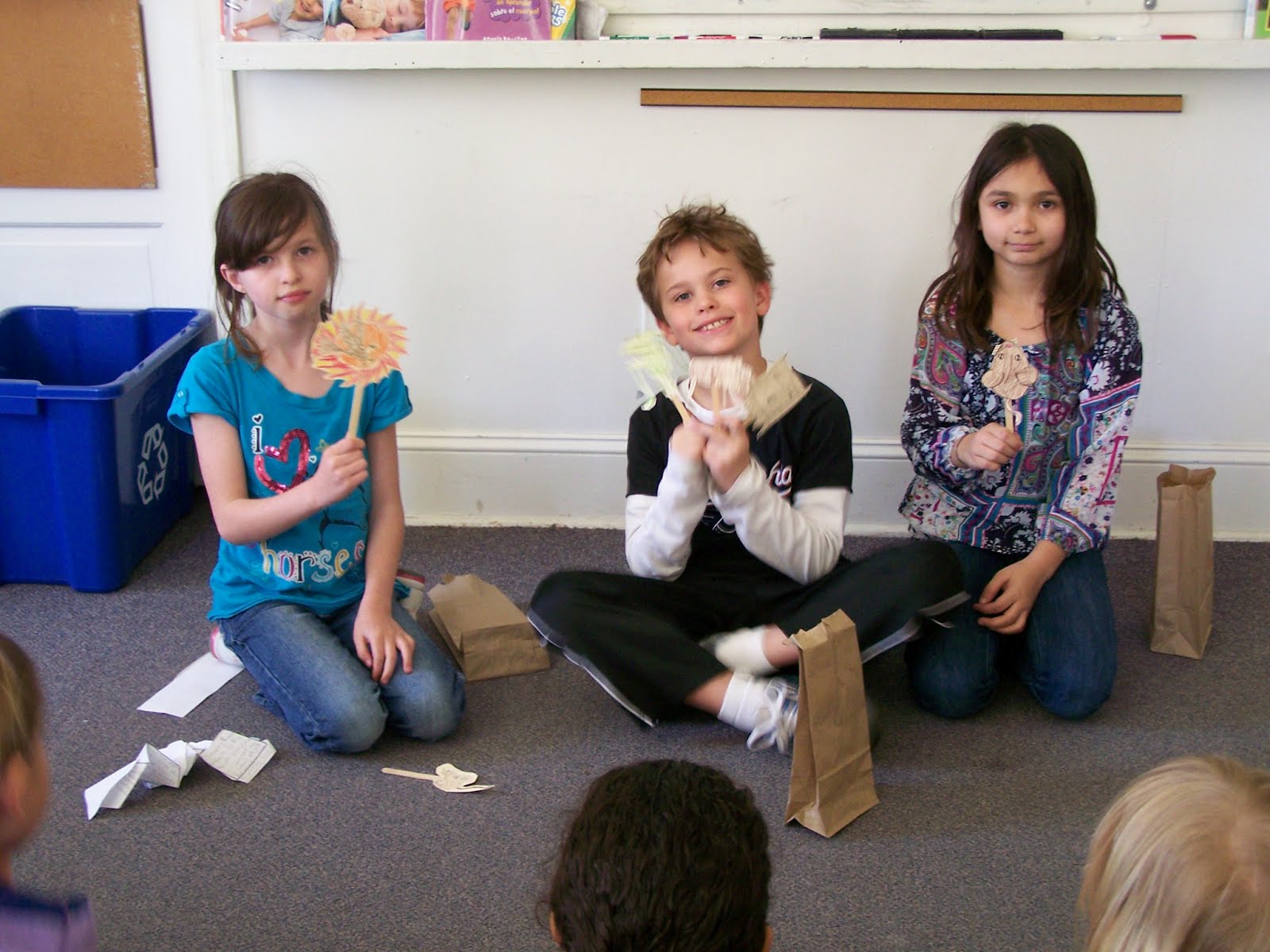
The fifth grade then gave an interactive presentation based on their study of Tibet and Buddhism. They first explained how Tibet's location and isolation influences Tibetan's need to work together, as well as Buddhist beliefs. They then performed two puppet shows (with handmade puppets crafted with T. Caroline) based on Jataka tales: The Banyan and Three Friends in a Forest. After each show, two fifth graders asked the audience if they had seen examples of Buddhism in the play, and if they could tell which character was the Buddha. The knowledge and composure displayed by our oldest students and the accurate responses from even our youngest students were impressive.

In reflecting upon the past three days, it has been gratifying to see all that the students have learned as well as the joy they had in sharing with schoolmates, teachers, and parents -- which are, in the end, among the major reasons for the All-School Unit at West Chester Friends School. The teachers will soon be turning their attention to choosing next year's theme. Until then . . .

Wednesday, April 4, 2012

Folktale Festival - Day Two

Yesterday, the students were both the storytellers and the listeners (see yesterday's post about Folktale Festival - Day One). Today, the students enjoyed listening to and learning from someone who makes storytelling his profession.

Robin Moore is an author and storyteller who grew up in the mountains of central Pennsylvania. He entertained all of us this morning with "true" tales from his childhood that stretched the truth just a bit -- like the one about the day that was so hot the corn popped itself. Students could hear in his stories characteristics similar to those found in the folktales and legends from around the world they have been learning in class. Some lucky volunteers got to try on authentically made Native American and Early American clothing.

Following the morning assembly, Robin conducted writing workshops for the upper grades and introduced them to his Four Secrets of Writing. The first is to "see the pictures of the story in your mind." Robin helped the students to do this by leading them through a guided meditation, accompanied by soothing music played on his Celtic harp. The second step is to write using your inner eye (imagination) and your outer eye (paper and pencil). The third and fourth steps are to rewrite and read your story out loud -- advice that I know matches what their teachers instruct them to do every day. Robin also described his work as a published author, including working with editors, illustrators, and translators.

Meanwhile, over in the gym . . . students acted out tales narrated by T. Amy. After listening to The Crane's Walk, an Aesop's fable retold by Brishti Bandyopadhyay, they practiced their crab walking skills. Rabbit Plays Tug-of-War, a Native American legend retold by S. E. Schlosser, led to -- you guessed it -- a good old fashioned tug-of-war.

The day ended back in the meeting house with a second assembly. As in the workshops, Robin led the audience through a visualization exercise. Ask your child to tell you about their imagined trip inside their family tree and the symbol for their family that they found there. For the grand finale, Robin had students join him on stage for a rousing audience-participation story about how the rabbit lost its tail.

The Folktale Festival wraps up tomorrow. More to come . . .

Tuesday, April 3, 2012

Folktale Festival - Day One

Today is the first of our three-day Folktale Festival, a celebration of this year's All-School Unit, "Folktales and Legends." Since the beginning of the year, students have been learning about this theme through special lessons and activities with their classroom teachers and in many of the special area subjects. These festival days provide an opportunity for students throughout the school to share what they have learned and accomplished with each other, and to celebrate the art of story telling.

At the conclusion of this morning's very first performance (kindergarten's puppet show for the fifth grade) I smiled at the realization that the festival was already meeting one of it's major goals. It was gratifying to hear our oldest students offer very specific and thoughtful words of affirmation and commendation to their younger buddies. Similar interactions happened throughout the day as children of various ages asked questions and appreciated each others' work.

Some of the events were designed specifically for a student audience, while others lent themselves to include parents. I have the great privilege of taking in all of the festival performances, displays, and activities. am glad to share the following images from the day . . . with more to come tomorrow!

Day One

Kindergarten's puppet show, "Tales of Kindergarten," explained various parts of their day (morning message, math, science, music, etc.) to their fifth grade meeting buddies.


First grade presented two shadow puppet shows: The Rumor, A Jataka Tale from India (taken from the book by Jan Thornhill) and The Rooster's Antlers, A Story of the Chines Zodiac, as retold by Eric A. Kimmel. Fifth graders recognized characteristics of the Indian story from their own study of Jataka tales.

Pre-kindergarten acted out the story of Kumak's Fish, A Tall Tale from the Far North, by Michael Bania, as narrated by T. Annmarie. Their performance was recorded in order to spare them the pressure of a live performance. Parents got to see the video today, and the rest of the school will view it on Thursday.


Second graders hosted visitors to their "Fairy Tale Gallery," where original fairy tales and illustrations were on display, as well as castles created through cooperative teamwork. Visitors enjoyed snacks of ogre eggs and troll stew!

In art class, second graders glazed their ceramic dragons.


Third graders, divided into small groups, shared The Story of Jumping Mouse, a Native American tale from the Plains region, with first grade audiences.


Fourth grade told The Groundhog Wars, a Pennsylvania folktale by Robin Moore, using expressive narration and handmade illustrations (including a homemade version of a "tunnel tickler").


Robin Moore will be our visiting artist tomorrow. Until then . . .

Tuesday, November 22, 2011

Listen!

Last month I wrote about story telling. Recently I’ve been thinking quite a bit about the flip side of story telling: namely, listening.


Active listening is as important a skill as the ability to create, write, and tell stories. If stories (as I wrote last month) help to weave the fabric of our society, bind us together, and are integral to the human experience, then it should go without saying that intentional and focused listening is also right up there on the hierarchy of essential skills.


The encouragement and development of listening skills occurs at West Chester Friends School from the earliest moments of each day. During morning meetings (an integral part of Responsive Classroom), students and teachers first greet each other while making eye contact and using names, taking turns to speak and listen to each other - a simple task that is at the heart of good communication. Morning meetings also include sharing when, again, as much emphasis is placed on listening and asking questions as on whatever is being shared.


Listening is essential to learning experiences throughout the day and is particularly important during special events. When, for example, the fifth grade opened the doors to the Native American museum they created last week, younger students were instructed before entering to be a good audience for the oldest students’ presentations - and they were! Tomorrow, during Grandparents and Special Friends Day, many students will spend time hearing about what school and life in general were like for their elder friends. Such inter-generational conversations are invaluable.


Meeting for Worship is the centerpiece of our week. While some may say that it is simply “sitting in silence,” it can be a much deeper experience. Many Quakers describe meeting as sitting “in expectant waiting,” listening for the “still small voice” that is in each one of us. While the “success” of a meeting does not depend upon whether anyone speaks, it is encouraging when students do rise to share a message - what Quakers call “vocal ministry.” The act of listening to these messages, and taking them with us, play an equal role in the vitality of a meeting.


Last week I had the good fortune to hear Michele Norris, co-host of NPR’s All Things Considered, speak about her new book, The Grace of Silence. In the wake of the 2008 presidential election, she had “set out to write a book exploring America’s hidden conversation about race but changed course when (she) started listening to the hidden conversations in (her) own family.” In several cases, Norris told her audience, she needed to wait patiently for months before some stories were shared. The result of her patience and listening is a compelling memoir, not only of her family, but of a not-so-distant piece of our nation’s story.


From Michele Norris I also learned about the National Day of Listening, which is coming up this Friday. The day was established by StoryCorps as an encouragement to sit and have a meaningful conversation with someone special on the day after Thanksgiving, rather than head to the mall. You may be familiar with StoryCorps’ project to collect audio recordings of interviews as an oral history archive. Trying to accomplish that may be too much for this weekend, but it’s not too much to simply sit with a relative or friend . . . and listen.


This year, the theme for the National Day of Listening is “Thank a teacher,” with the suggestion that we reach out to a favorite teacher - by calling, writing a note, or posting a message on their site - to say, “Thank you for touching my life.”


What better way to show that we were listening?


Thursday, October 20, 2011

Will You Tell Me a Story?

“Will you tell me a story?”

These words evoke an image of a young child sitting on a lap or under the covers wishing to hear another tale told by a caring adult – a nostalgic scene that we remember from our childhoods and, if we’re lucky, get to relive in our adulthood as the storytellers.

We all have stories to tell. When we share our experiences by telling and listening to stories, the fabric of our society is woven. Stories bind us together and are integral to the human experience. They inform us about our past and help us make sense of our present. As it turns out, they are also essential to navigating our way in the future. As Daniel Pink explains in his New York Times bestseller, A Whole New Mind, story is one of six right-brained aptitudes that are necessary for success and fulfillment in what he calls the Conceptual Age, and that are often under-emphasized in schools. As we emerge from the Information Age, with facts being “so widely available and instantly accessible, each one becomes less valuable. What begins to matter more,” Pink writes, “is the ability to place these facts in context and to deliver them with emotional impact. And that is the essence of the aptitude of Story – context enriched by emotion . . . a deeper understanding of how we fit in and why that matters.”

Story is a part of our daily lives at WCFS beginning with our youngest students and the earliest minutes of every day. Students begin their day with Morning Meeting which often includes time for children to share what is important to them – their personal stories. Literature is the foundation of everything that we do in the language arts; in order to tell a story, you need to be able to hear and read a story. As students learn to write, they draw first upon personal experiences for subject matter. Third graders learn, record, and pass on their families' stories as part of their study of Immigration. Storytelling is even a part of music classes, where instruments are used to evoke feelings and emotions in the telling of "sound stories." Intergenerational experiences such as Grandparents' Day and visits with our neighbors at The Hickman are reminders that listening is a major (and often overlooked) component of storytelling. This year, the faculty have chosen “Folktales and Legends” to be our all-school theme, placing even greater emphasis on the lessons to be learned from tales of the past.

As members of the WCFS community, we all have stories about our most memorable school experience. One of my favorites is about the birth of our daughter on the first day of school in my first year as Head of School. On the other end of the spectrum, I recently recounted on my blog the story of how, just five days later, we experienced the events of September 11 here at school.

I invite you to share your WCFS stories. In celebration of the school’s 175th year, we are collecting 175 memories from alumni, alumni parents, current and former faculty and board members, Meeting members, and friends. Any and all memories are welcome from specifics about a particular teacher, activity, subject or event, to something broader (“I loved playing on the lawn.”). Short or lengthy, funny or poignant, we want to hear what you think of when you remember WCFS. The stories will be compiled in a book that will be available for purchase and go in our archive. Some will also be shared on our web site. You may mail your memory to the school, email development@wcfriends.org, or leave a message at 610-696-2820.

Will you tell us a story?

Thursday, September 15, 2011

What a Way to Start the Day, the Week, the Year

Every week at West Chester Friends School begins with a celebration of community called “Gathering.” All of the students and teachers form a circle in the schoolyard and greet each other by shaking hands and saying, “Good morning,” with those on either side. Children are encouraged to include their friends’ names and to smile. You can feel the mood lift when there are smiles passing around the circle.

Next, students from each class share a highlight from the previous week or their anticipation of something in the current week. This week, for example, fourth grade announced their Word of the Week (it’s “cygnet,” which means “a young swan”), fifth grade told us that homework had begun, third grade welcomed a new student, second grade shared that they learned a card game to help with math facts, first grade announced that they are making their doves, and kindergarten proclaimed, “Kindergarten is fun!”

The greeting and sharing are elements from the Morning Meeting, an aspect of Responsive Classroom which happens in the kindergarten through fifth grade classrooms every morning (pre-kindergarten introduces these elements later in the year).

Children whose birthdays are coming up in the week hear their name called and receive the well wishes of everyone in the circle. Announcements are then made. These range from reminders of upcoming events to recognition of a job well done. Finally, we sing a song – an uplifting way to transition into the rest of the day.

With this being the first week of school, T. Rege arranged for Sage Larsen ’13 to perform a song that has a wonderful story behind it. Five years ago, when Ellie Kerns ’11 was in first grade studying the Civil Rights Movement with T. Connie, she wrote the song, “Stand Your Ground.” She and her classmates performed the song at Gathering that year, and we have enjoyed it from time to time since then. This summer, Ellie and Sage attended a week-long band camp, during which they rewrote some of the lyrics, wrote the music, performed and recorded a dvd.

Listen to a version of the song with both girls singing. It was recorded in a studio and includes piano and drums in addition to Sage’s guitar. While you listen carefully to the words, imagine Sage standing in the circle with just her acoustic guitar, singing confidently for all of us.